27 January 2013

Steady as She Goes -- Week Ending 26 Jan

Things have settled into a nice groove for the semester, it seems. I have been able to organize my time and tasks well, and I've been keeping up with all the different projects I have a stake in. Let's hope it runs smoothly through the whole semester and that fantastic results come of my work!

***
Last March of the Dodos
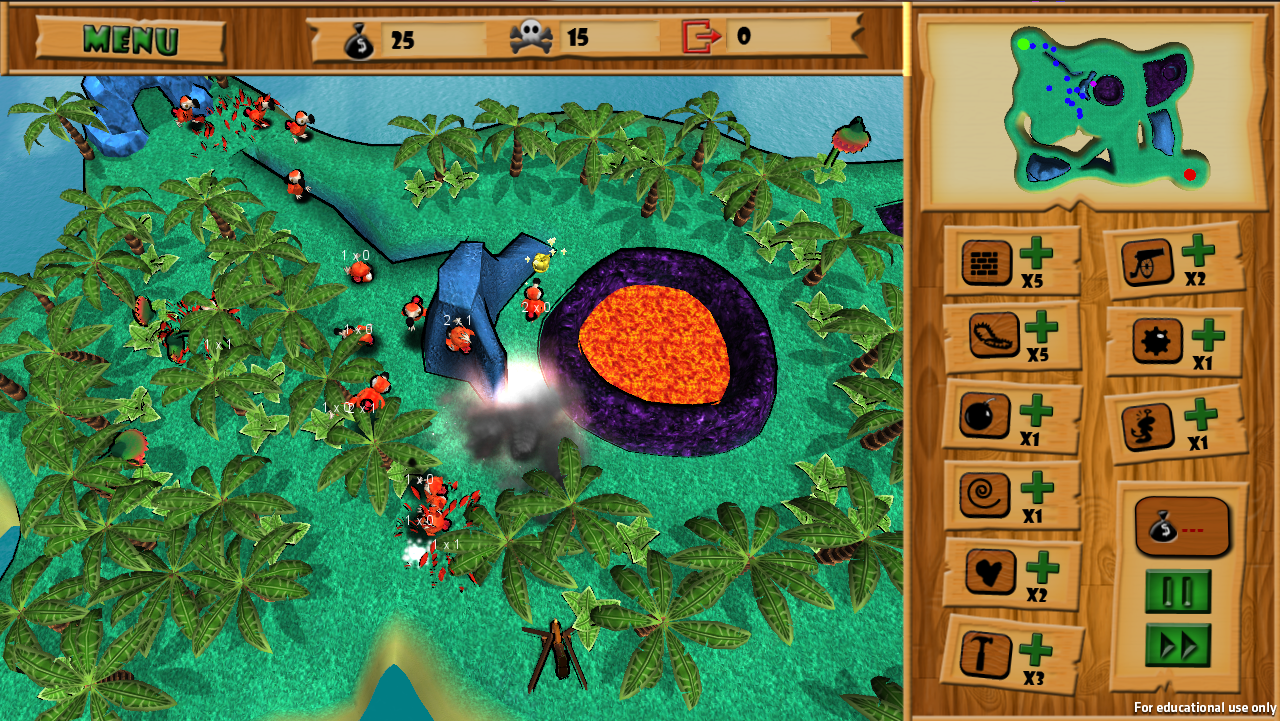
It was another productive week for Dodos. We've added some minor new features to round out the experience more, though they're still not totally polished. First, there's now a countdown at the beginning of every level to give the player just a bit of extra time to scope out the layout before the Dodos begin their march. This allows for more intentional strategy, but it does not kill the frantic experience of having to adjust and manage the birds in real time--best of both worlds! I designed the look, transitions, and timing of the countdown and worked with Kamron as he implemented the feature. Also, I created the art assets (the numbers and text art) for this--sometimes the best help I can give is to just do whatever needs doing, even if it's not necessarily my particular focus.

Second, there is now an achievement system in place! As we've come to learn for ourselves (as well as from our new production and publishing faculty member, Amy Adkins), achievements are necessary for this type of game (if not every type). The system is still quite early in development, but the framework is there. Things will really start moving once we've finalized all the levels and can determine all the unique things we'd like to challenge the player to accomplish. I helped design where the visual elements would appear as achievements are earned, as well as what types of achievements will be in the game, while Derek created the framework and engineered how the system will work.

We also continued work on the UI and menu design. Christine is doing a great job with the art, and I've been designing where the various elements should be located and how the functionality works. Even with the relatively simple changes we've made so far, the game already feels quicker and more streamlined to enjoy.

Further, we've constructed our new splash screen, and the invitation to play is far more appealing because of it. I guided I Kamron in what to do with the level model, rotating camera, and title logo. We're happy with how all these additions are bumping our game to the next level.

Finally, I've started figuring out how to use HanSoft, a common software tool in the industry for managing the game development process. Amy has been helping me understand the ins and outs of the software, and I've started transferring our dev process for Dodos to it. The real trick will be getting the team on board if we decide that it will be official. Either way, it'll be a great skill to have under my belt for the industry.

The Leonardo Project
Our pre-production phase is moving ahead and nearing its close. We've had several meetings to discuss our individual research and determine what the necessary pieces of the game will be. Roger has been guiding these design meetings based on a new approach that he's devised: a figurative box made of four walls--the tech wall, the audience/theme wall, the aesthetic wall, and the gameplay wall.

Part of my duties has been to take pictures of our whiteboard notes, then interpret them and share them with the team via our Google Drive. It's helped to keep everyone aware of any different directions we take from meeting to meeting, especially for those members who haven't been able to attend every time.

This week, I was tasked with researching public art and museum exhibits to determine what exactly was the draw--the hook--for each one. Based on the dozens of pieces I investigated, we determined a number of things that help these types of experiences stand out:
- Touch and/or physical movement involved in the interactivity
- Scale is important, even if the size is inconvenient for some
- Interactivity results in immediate feedback, so users know just what they've done to the exhibit
- If it's a game, the goal(s) should be made evident to the players, even if they still have the option not to contribute to that goal
- It should aim to generate some conversation, if not outright controversy
- It should be an experience that is situated and unique, something they can't get anywhere else
- Finally, within the limited time that people spend at such exhibits, they need to be able to 1) prepare for the game, 2) learn and understand how to play it, 3) play it sufficiently, and then 4) reflect on the experience and contribute to the conversation.

Reveal
To begin the week, we had a meeting to get our development process started. We broke down the game design into user stories and tasks, and we then began our first sprint. As part of the meeting, I helped explain the newly adjusted design details (as of last week's completed design document) to all members of the team so that we are all on the same page and can determine a clear direction for developing those features.

For my responsibility this week, I was assigned the task of designing and documenting the various user stories relating to enemy AI (including the AI for Void, the boss enemy), plant and environmental interactions, and what the upgrade Elements do for the player and the gameplay.

The engineers are hard at work learning how to use UDK and have started developing features based on the user stories. As long as we keep to our schedule, we should be able to reach our goal!

The Macromancer
Little has happened since last week, other than keeping up with all the team members to track any progress that's been made. As expected, once classes started, it has proven difficult to keep steady progress on volunteer projects. However, it's still definitely alive, and this weekend's Global Game Jam should provide some great advice, experience, and understanding of developing on Ouya.
***

I hope to have a bit of news on my side design projects by next week, so keep checking back!

- Troy

21 January 2013

Putting Rubber to Road -- Week Ending 19 Jan

This week I don't have any particular musings about being a designer-producer nor any other general thoughts to share, so I'll just jump right into discussing my four primary game projects. Enjoy!

***
Last March of the Dodos
This was an excellent week for nailing down distinct plans. Our team lead (Jesse) and I walked through every step of the game together to determine the specifics of what needed to be updated, changed, fixed, or added to make the game feel like it is really supposed to. This list has become or newest backlog, and we are prioritizing it as we speak so that we hit the most important pieces early on. Some of those prioritized tasks and features include the implementation of a countdown at the beginning of every level ("10 seconds till the Dodos march!") to give the player time to scope out the stage; a redesign of several pieces of the UI and certain menu screens (making elements that appear on multiple screens fall in the same place on each different screen, balancing spatial relationships, adding placeholders for necessary points of information, etc.); making the stages visible behind the buttons and mini-map; and much more that will really help the game flow.

As part of fulfilling my own tasks from the backlog, I helped with the UI redesign, designed the countdown feature and exactly how it will behave, spear-headed effort to correct the level visibility and camera-control issues, and designed some new aspects of the title screens and menu contents.

Also noteworthy was that this week we were introduced to our new production consultant, Amy Adkins. I'm not entirely sure of her official faculty status, but she was a producer at EA for years, and she has been hired to help us all polish and publish our games. She has jumped right in with great advice, insight, and expectations. She asked us to compile and send her a group of documents for our project, including our backlog, design document, schedule, publishing plans, etc. This request proved quite helpful to us, as it forced us to really sit down and hammer out details to a degree that we simply had not done previously. I ended  up compiling the package for her (and creating whatever documents that did not previously exist), and it helped me visualize and understand the process we'll be driving through much better. We now have a much clearer vision of what we must do--and what we will do--over the next three months.

Amy played our game and said that she definitely felt like she could get people to play it. She projected a target audience of children based on the aesthetics and feel of the game as it stands (slightly younger than we originally intended due to the complexity of the game and the issue of killing/extinction), so we're now figuring out the best way to shape the rest of our development based on these reactions and our original goals. She opted to withhold any further feedback until she speaks with Mark and Craig to better understand their expectations of our game from the academic side, but she seemed genuinely excited by what our game can be and what we can do with it over the next three months.

The Leonardo Project
This was a good week for pre-production. Roger appointed me to be the lead producer for the team, and I was immediately put to work. I scheduled two meetings with the team--one of which was our first meeting with Alex Johnstone, our contact from The Leonardo--and we have really gotten the juices flowing for coming up with our game design.

I created a Google Drive and Google Calendar so that we would have a common place to look for any and all assets and communication needs that might arise. Thus far, the tools have been quite helpful in keeping us all on track together and making sure everyone can access whatever he or she might need. Further, I set up a Kanbanpad.com project for us to track our backlog and scheduled development tasks; the service is free, and it's online so we can all see and edit it from any device. We may end up using Hansoft if we get licenses for our forthcoming workspace in The Leonardo, but we'll stick with Kanbanpad for the time being.

When we met with Alex at The Leonardo, he gave us a tour of the space, and we're excited to be associated with so many cool exhibits. The venue is perfect for a public game like the one we'll deliver, so we look forward to generating buzz with a transparent development process.

I'll hold off on delving into design details at the moment because we've simply thrown around too many to list, and it would be difficult to make much sense out of such a collection at the moment. However, feel free to investigate the image of the whiteboard and try to decipher what it might all mean... Suffice it to say, the experience is going to be awesome and thought-provoking. I promise.

Reveal
You'll notice that the title of this game changed from last week; that was no accident. We spent several hours considering what our point with the game is, and in an attempt to come up with a suitable slogan for our pitch and design document, we finally hit upon it. After evaluating the focus of our gameplay and the hook of the experience, we determined that revealing the unknown (or the "difficult to interpret," at least) is what our intended experience hinges on. By using a couple abilities that can manipulate the existing bioluminescence in the world or generate light independently, the player can discover the secrets of the environment and determine how to eventually escape from the lurking dangers. Thus:

Title: Reveal
Slogan: Master the light

Based on this approach, Andrew Witts, Jason Thummel, and I spent about 30 total hours (between the three of us) creating the official design document that we had to submit to Ubisoft this week as part of the GameLab competition. We're pleased with how it turned out, and we're confident that we can develop an awesome game from the details outlined within it.

It feels like the whole team is definitely on board with this new interpretation of the original prototype and pitch, and we've started putting things in action. The engineers met with members of the first EAE:MGS cohort for some tutoring on using the UDK and getting the core features they had built using Unity into the new engine. In addition, our artist, Isaac Kellis, cranked out some awesome new concept art, which you'll be seeing in future posts.

Now that the document is written and submitted and we all have some idea of the tools and process we'll be using, we'll kick production into high gear starting this coming week. We can't wait to create a killer game that will win this competition!

The Macromancer
Progress continues with The Macromancer. The team had a meeting on Friday (which, sadly, I was unable to attend because of my meeting at the Leonardo) in which the engineers got handheld controllers to work with the game (no longer bound to mouse and keyboard controls). Getting the game to work with the Ouya is still proving to be a nuisance, even with all sorts of online investigation for a solution, but pieces are snapping into place and functioning properly bit by bit. In other words, it feels like the same process as every other time we are presented with new tech. We're confident that we'll have everything working with the Ouya Development Kit (ODK) by the end of the coming week.

Design-wise, the game is in the same place it was since our public pitch. We'll likely trim down the story and narrative plans we had, but the gameplay remains. With the positive response we received about our core mechanics from the presentation, we're happy with how the game feels, and we're stoked that the team is still dedicated to pushing forward with its development. Ouya officially releases in just a couple months, and we plan to release a solid game on day one! Wish us luck!
***

Have a good week, and keep tabs right here. I guarantee you'll be interested in what's to come!

- Troy

15 January 2013

Polishing to Publish -- Week Ending 12 Jan

Happy New Year! With the beginning of my final semester in the EAE:MGS, I've decided to alter the format of my blog posts ever so slightly. Instead of my typical flood of information about everything that may or may not be going on, I'll break my thoughts down into discreet sections for each individual project that I'm involved in. With this approach, I hope to motivate myself to actually do something on each project each week, even if it's no more than a tweak to a design document or an evaluation of a sprint. That way, I hope to ensure that none of the games slip through the cracks into development Limbo.

Let's get to it, shall we?

***
Last March of the Dodos
This week has been a matter of evaluating the game as it stands and determining our plans for getting it published by the end of the semester. There has been little actual work on the game, but I've done a hefty bit of research into our publishing options and what we will have to do to set the processes in motion.

Presented with the information I gathered, the team has decided that we do, in fact, want to push for a release on Steam, and we're willing to do what it takes to get the greenlight--"Steam Greenlight," that is! Ha! Beyond that, since Steam does not require exclusivity, we are also shooting to release on Desura shortly after our projected Steam launch to increase our exposure by whatever degree possible. I've been talking with our tech lead, Kamron Egan, about what it will take to meet all of the technical requirements outlined by these services, and he thinks we can achieve them, but we'll need to hit the task hard and fast. So that's the plan!

The Leonardo Project
For my internship this semester, I am a producer on a game that the Utah Game Forge is developing as a joint venture with The Leonardo, a local art-meets-technology museum/exhibitor. We're still in the early design process, so my work this week has been researching location-based games and the interesting styles of play that they can offer.

So far, the standout games I've discovered are Life is Magic, TapCity, FourSquare, Shadow Cities, Ingress, Nintendo's "StreetPass" features and activities on the 3DS, and geocaching. Though they're not necessarily all games by strictest definition, each has a unique way of giving people a fun and interesting reason to get out and explore the world around them (or at least travel about a bit).

I'm incredibly excited about this particular opportunity, so I can't wait to see what we come up with as a team over the next week.

Cleanse (working title)
Pitched and prototyped by members of Cohort 3 (current first-year Master's students in the EAE:MGS), this game was selected by our faculty to represent us in the Ubisoft Gamelab competition (we're the only American school invited to participate in the competition this year!). With an extra open spot on their team, I was asked to join them to assist and consult in the production and design of this "promise of a promise" prototype. We'll be evaluating and fleshing out the prototype over the next three months in preparation for the competition in April. If we win, our whole team will be interning at Ubisoft Montreal over the summer to build a full version of the game! Needless to say, we're stoked about the prospect. :)

So far, my work with this team has been attending meetings and helping formulate stronger mechanics and overall design details. I'm pleased that some of my suggestions inspired great discussion about the future of the game, and some features that I came up with are now a part of the core experience, including what we have termed the "pulse" mechanic. Because the world on which the player finds himself is completely dark except for bio-luminescent nodes on plants and creatures, the player must use this pulse ability to enhance the brightness of those nodes as the pulse wave passes around and through them. This acts like a sort of sonar or "Daredevil vision," but it can also stimulate specific reactions from the player's surroundings. One common use for the pulse is the final blow to light up weakened enemies, thus transforming them into friendly, useful critters.

The design document that we must submit to Ubisoft is due next week, so I imagine that I'll be directly involved with constructing that document.

The Macromancer
This is the game and team that I was originally a part of in our bid to enter the Ubisoft competition. Although we did not get chosen, we were informed that the faculty thought our core mechanic of shrinking and growing objects to manipulate their uses and abilities was likely stronger than the other games' mechanics (there was just something more unique about Cleanse that pushed it to the top). Because we felt the same (and we had great confidence in our core play from our early design meetings), we knew that we wanted to continue development, with a goal of releasing the game on Ouya. Spencer, our team lead, recently received his early Ouya development kit, so we have already begun working on making sure our Unity project plays nice with the new platform and controllers.

We're in a great place so far, with our hook firmly present and playable, so we're happy that the team is still committed to developing the game on our own time.
***

Other than that, I'm still hard at work designing a few other independent games that will also receive some face time in this blog. Having also started on the companion document to our thesis game (heretofore known as my thesis paper), I'm keeping plenty busy. Which reminds me, we took the first part of our comprehensive exams on Thursday, and I feel like it went very well. Part 2 (the essay portion) was postponed until Monday due the the University calling a snow day on Friday, but I feel confident that I'll do very well on that portion as well. Either way, wish me luck in all of this!

- Troy

14 December 2012

Until Next Semester! -- Week Ending 15 Dec

Well, this week was more about wrapping up final projects and loose ends for all the other classes we had (it is finals week, after all), so direct work on Last March of the Dodos was minimal. However, I did lay out plans with Jesse on which items of business will be most important to address and work on at the beginning of next semester. We're super excited to polish our game up the best that we can. With all the positive feedback we received last week, we are confident that we can really make this baby shine by the time we officially publish it next semester.

With those things in the works, I figured the best way to finish off my blogging for the semester would simply be to post some videos of the current build of the game in action. I hope you enjoy this preview of what's to come!


Happy Holidays to one and all!

- Troy

11 December 2012

A Successful Semester! -- Week Ending 8 Dec

I'll keep this introductory paragraph brief because there's more interesting stuff that follows. Suffice it to say that this week was all about getting ready to show off Last March of the Dodos. I am pleased to report that the public really likes it! From non-gamers to gamers, students to faculty, and amateurs to professionals, the response we heard from people who tried our game was almost entirely positive (if not entirely!). I want to take a moment to thank our whole team for all the hard work they've poured into the project. It's been a long road (and we're still not finished yet!), but we've learned a ton, and we're thrilled that people are having fun with what we've created so far.

Here's what I did this week:

- Prepared public display materials for our game and sent them to Rachel so that she could compile and print them; this included taking screen shots, capturing video of the game in action, writing instructions on how to play the game, and writing appealing descriptions for "marketing" purposes
- Loaded our game onto our designated computers for Arts/Tech night and for the EAE Open House
- Volunteered at the Arts/Tech night to guide visitors through our studio
- Helped guide visitors and make contacts at the EAE Open House

With that out of the way, I want to note several things that we heard (or observed) from new players during the Arts/Tech night and the EAE Open House. It was quite valuable to have fresh eyes and hands on our game!

 Praise:
- A non-gamer woman in her 50s wanted to keep playing after continual failure. She was intrigued and wanted to keep getting better at the game. Part of her inability to perform well was because she had trouble using a two-button mouse (I'm guessing that she either uses a Mac or doesn't use computers regularly). She also said that she actually thought it was fun. After 5 or 6 attempts, she did successfully complete the first level.
- Many people really like the Dodos' animation. I heard "it's so cute" about a dozen times. Mission accomplished.
- People enjoyed the toony feel in the aesthetics.
- The various traps and their different uses and effects went over very well. A few players commented specifically on how the traps each felt unique and that they understood the point of having them all available.
- It's fun! People liked the pressure of having to keep up with the Dodos and continually be involved in the placement of traps at all times. The feeling of setting a trap in a great place was very rewarding.
- Tossing the Dodos around--especially to specific places like volcanoes--was also rewarding.

Suggestions or negative experiences:
- Messaging can definitely be cleaned up. Certain pieces of information are shifted around from menu to menu (Doin display, for example), there's not much to tell the player whether they're doing poorly, etc.
- Specifically, some sort of marker that floats around the border of the viewing area to designate which direction the entrance, escape exit, and king Dodo lie in would be great.
- A "safety" or "warning" meter/marker that alerts the player to Dodos getting close to the exit would be great (could flash red when a Dodo escapes)
- Appropriate visual and audio cues that celebrate the player's successes are a MUST. Chimes, bells, sparkly numbers, flashes of light, Dodo squawks, etc!
- Get the hot air balloon nest in the game and have it fly off when the level ends! Giving the player a visual reason to not let them escape would make the point even stronger.
- The camera still gives some people trouble (make the UI on the right side of the screen transparent so that people more naturally push the mouse to the far edge of the visible map to move it...?).

So there you have it. Check back next week for the final installment of the semester. Here's a teaser: GAMEPLAY VIDEO!

- Troy

03 December 2012

Semester's End Is Looming -- Week Ending 1 Dec

The goal for the last couple weeks of the semester is to ensure that we have the best possible product to show off at the EAE Open House on 6 December. Though it's no secret that many students in the cohort had a bit of shift in focus once we submitted to IGF (other classes and homework have to get done sometime!), we've still been hard at work polishing and optimizing the experience of our game. The open house is next week, so much of this week was spent making the game easier to learn, thus giving players the greatest possibility of experiencing all that the game has to offer in a relatively brief play session (at the open house, we don't expect players to have the time to play for more than five or ten minutes).

Here's what I did this week:

- Assisted in getting the new color palette implemented. Might be a little bright for our tastes, but we want Craig to look at it for critique
- Got all text tips implemented into the game. They are present on load screens, various stages of menu pages, etc.
- Wrote the text for trap descriptions and put them on the trap store screen. These act as quick reference for players when they're deciding what traps to purchase for the oncoming level.
- Fixed the functionality of broken lava pits. This involved working in Unity to adjust some prefab settings, resizing objects, and digging through the nitty-gritty of some numbers and values.
- Tested trap functionality like crazy. Suggested tweaks to certain collision detections (which were implemented by the engineers), modified the design of trap launch trajectories, etc. Also tweaked the rate at which Dodos learn specific traps and then break or avoid them.

Just a couple more days till we're set to go! We're excited to get the public's feedback, including suggestions and comments from industry professionals that will be attending. Wish us luck!

- Troy

27 November 2012

Give Thanks for Progress! -- Week Ending 24 Nov

Once again, the week was cut a little short by a much-needed Thanksgiving break (not that we needed a break from working on our game--more of a much-needed break from class and homework in general). However, we did have a day or two together, so we did get some things nailed down. Here's a quick run-down of what I accomplished this week:

- Determined a few potential color palettes with Jesse (this was one of our specific goals from critiques we received from Craig). At least one of the palettes should be fully implemented by Monday the 26th.
- Nailed down new level progression and meta game details that tie all individual levels into a persistent experience. These new ideas change the way future levels are experienced/played, and it puts a slightly different spin on the game from the way he built it up to this point. I do believe, however, that these changes are for the better, and not just a troublesome bout of feature creep.
- These changes include incentives for skill mastery on each level to progress (rather than repetitive grinding). High scores now aggregate, with new high scores replacing old ones from the same level, and they combine to give the player a total high score. That score translates into Doins which can be used to purchase traps before beginning a level.

Until we meet again, Happy Thanksgiving! Enjoy the beginning of your holiday season. I know I will. :)

- Troy